
We launch a new series in which the term hedging goes beyond its classical interpretation as risk reduction, embracing a broader definition:
Hedging := the deliberate control of the distribution of outcomes through market instruments. This includes:
- risk reduction (protective puts)
- risk transfer (insurance-like structures)
- risk monetization (covered calls)
- adjustment of the payoff profile
Therefore, hedging can be formulated as a problem of decision over the shape of the outcome distribution, not merely over variance.
The shape of this distribution is, in general, influenced by several sources of risk, including:
- market risk
- interest rate risk (for assets sensitive to discounting)
- FX risk (for exposures denominated in other currencies)
To isolate the main mechanism of the covered call strategy, we restrict the analysis to the market risk component, treating the other sources as constant or negligible in this context. This simplification allows a clear analysis of the relationship between volatility (IV vs RV) and convexity (Gamma).
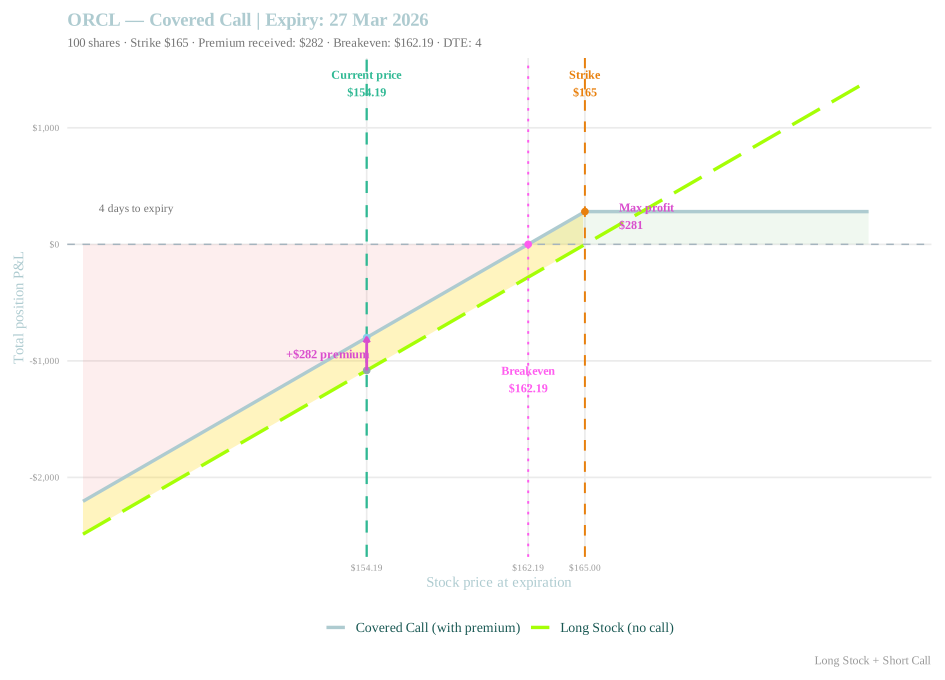
In the case of the Covered Call strategy (selling a Call option while holding the underlying asset), the central mechanism is not directional speculation, but rather volatility transfer.
When we sell an option, we effectively sell volatility (we are short vega). We transfer the risk of an explosive upward move to the counterparty, in exchange for a premium received upfront.
From a distributional perspective:
- we truncate the right tail (cap the maximum profit)
- we increase the density in the central region (higher probability of moderate outcomes)
In other words, we sacrifice rare but large asymmetries in exchange for more frequent and more stable outcomes. This transfer is not mechanical. Selling a Call is justified only when there is a convergence of conditions.
Decision Framework: The Zone of Acceptance Link to heading
We define a zone of acceptance as a subset of the parameter space in which the risk–reward ratio becomes favorable for the covered call strategy.
We initiate a covered call when we are within the following zone of acceptance:
- implied volatility is high relative to the asset’s historical behavior
- the price is located near a relevant technical level (e.g., resistance)
- maturity is in the range of 30–45 DTE
- the strike is approximately 5–10% above the current price
- the strike lies in a region where we are willing to relinquish the asset
1. Volatility Premium (IV vs RV) Link to heading
This is the fundamental criterion. We sell volatility when:
- implied volatility1 (IV) is elevated
- realized future volatility (RV), as estimated from available information, is lower than IV
In practice, we sell risk that we consider overpriced relative to its likelihood.
Structurally, we give up part of the decision flexibility (a superposition) in order to collapse part of the uncertainty in advance, in exchange for an immediate premium.
2. Directional Conviction Link to heading
Covered calls are incompatible with scenarios of rapid upside. The strategy is appropriate when we anticipate:
- a sideways market
- slow growth
- no major catalyst
- periods of waiting before relevant information or decisions2
3. Temporal Structure: Where Theta is Efficient Link to heading
Time decay is not linear, but accelerates as expiration approaches.
-
the 30–45 days to expiration (DTE) range provides a favorable trade-off between:
- premium accumulation
- and convexity risk (Gamma)
-
in this region, the Theta profile is efficient relative to the risk assumed
In practice:
- position initiation occurs in the 30–45 DTE range
- rolling or closing is typically performed around 7–14 DTE, when:
- Theta has been largely captured
- Gamma begins to dominate
4. Convexity Risk Control (Gamma) Link to heading
A critical, often overlooked point:
- options with very short maturities (<14 days) exhibit high gamma
- small movements in the underlying can produce disproportionate changes in Delta, amplifying exposure in a nonlinear way
- this dynamic requires active exposure control, as small price changes can significantly alter Delta and necessitate frequent adjustments
Exit strategy Link to heading
A covered call strategy requires an explicit, ex-ante defined exit rule in order to avoid reactive and inconsistent decisions. In the absence of such a structure, the strategy risks becoming a simple premium collection approach without real risk control.
1. Early profit-taking (buy-to-close)
This exit occurs when the option’s time value has been largely consumed, and the marginal benefit of maintaining the position becomes insignificant relative to the remaining risk.
Operational rule:
- The option is repurchased once approximately 80–90% of the premium has already been collected
- Capital is freed for a new call sale (roll forward), potentially adjusting maturity and/or strike
Justification:
- Theta decay has already been largely realized
- Residual risk/reward becomes unfavorable: the remaining profit potential is limited, while the risk of adverse movement in the underlying remains significant
- Adjustments are naturally made at the option level, not the underlying, as the strategy aims to optimize premium flow without altering the base exposure
2. Tactical exit before events
In the presence of events with potentially significant impact on volatility (earnings releases, dividends, macroeconomic announcements), maintaining a covered call position implies an implicit short volatility exposure. Maintaining the position under such conditions is equivalent to an implicit shift in strategy, from one based on time decay to one exposed to event risk, without a corresponding adjustment of parameters.
3. Consistency rule
Any exit strategy must satisfy a minimum set of structural conditions in order to remain coherent over time.
Principles:
- Exit rules are defined ex-ante and are not adjusted ad-hoc
- Decisions are independent of emotions or the current position outcome
- The strategy is aligned with the initial objective: income vs capital gains
Exiting a covered call strategy should not be treated as a singular event, but as a set of rules integrated into the decision-making process. Without such discipline, the strategy loses its systematic nature and becomes vulnerable to recurring risk assessment errors.
Structural Interpretation Link to heading
This framework is not about collecting premium, but about:
- deliberately choosing a truncated distribution
- monetizing uncertainty when it is overpriced
- accepting a controlled limitation of upside
In other words, we do not optimize each market move in isolation, but rather choose a stable form of exposure.
@online{Cornaciu2026CoveredCall,
  author   = {Cornaciu, Valentin},
  orcid    = {0000-0001-9239-7145},
  title    = {Covered Call as Risk Monetization},
  year     = {2026},
  date     = {2026-03-23},
  url      = {https://rcor.ro/posts/2026-03-17-covered-call-as-risk-monetization/},
  abstract = {We interpret the covered call strategy as a mechanism for risk
  monetization, focusing on the transformation of the return distribution through
  the sale of convexity. The analysis emphasizes the interaction between implied
  and realized volatility, time decay, and convexity risk, within a structured
  decision framework based on actuarial principles.}
}
This is the cornerstone of market investing, anchoring strategies in statistical inference, and grounded in disciplined risk management and actuarial principles.
 It is not necessary to master every detail of the underlying models—what matters is the ability to identify a qualified actuary who can construct and validate the appropriate framework, ensuring consistency, robustness, and alignment with the underlying risk structure.
-
In the context of options, the main sensitivities are:
Delta sensitivity to the underlying asset price Gamma rate of change of Delta (exposure curvature) Vega sensitivity to volatility — short vega loses when volatility increases Theta sensitivity to time — long theta benefits from time decay Rho sensitivity to interest rates In a covered call, we are typically short vega and long theta. ↩︎
-
The President of the United States, Donald Trump, announced on 23.03.2026 a 5-day delay in certain actions regarding Iranian energy infrastructure, in the context of ongoing negotiations. Such situations create a waiting period, during which the passage of time may favor short call positions. ↩︎