
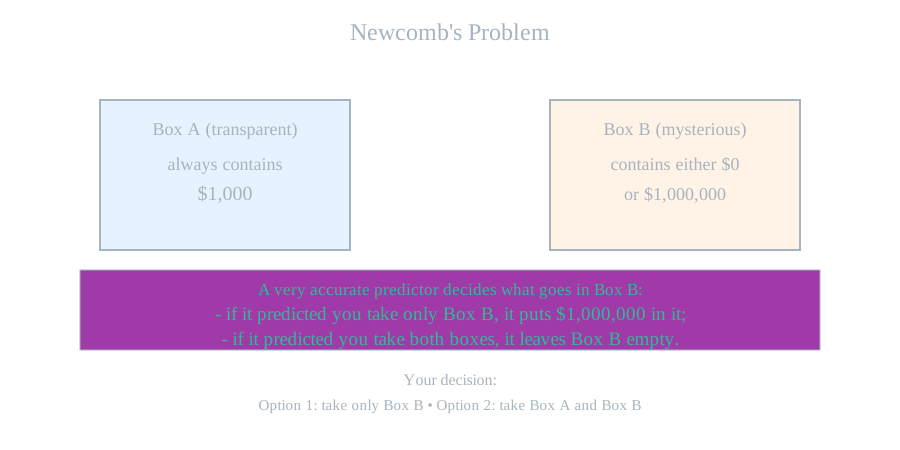
Newcomb’s Paradox1 is one of the most discussed thought experiments in decision theory, putting into tension two seemingly incompatible principles: expected utility maximization and the principle of dominance.
For an accessible introduction, see:
Standard discussions usually frame the problem in terms of:
- Evidential Decision Theory (EDT)
- Causal Decision Theory (CDT)
In this post, we propose an alternative structural formulation based on:
$$ \begin{gathered} \textit{the distinction between global and local reasoning.} \end{gathered}\tag{G→L} $$
Newcomb’s Paradox can be better understood by separating two ways of modeling decision-making:
- local: the decision is evaluated pointwise, conditioned only on the current state of the world.
- global: the decision is evaluated as part of a behavioral rule, anticipated by the game’s mechanism in a consistent way.
Premise Link to heading
We assume the existence of an almost perfect predictor:
$$ P(\text{correct classification} \mid \tau) \approx 1 $$
where $ \tau$ denotes the type of the agent — i.e., a stable behavioral rule.
In this model, the predictor does not merely observe a single action, but identifies the structure of the agent’s behavior:
- if you are a local agent, you will be classified as such
- if you are a global agent, you will be classified as such
In other words, the predictor operates at the level of decision rules (global), not just individual outcomes (local).
Game mechanism Link to heading
Within our model, the predictor does not react to your pointwise choice, but to your type of agent:
- local agent → the large box is empty;
- global agent → the large box contains $1,000,000.
Fixed point: the local trap Link to heading
Local reasoning can be viewed as a deliberate simplification: the decision is evaluated pointwise, without an explicit mechanism for aggregation at the level of a general behavioral rule.
In other words, the agent model is modular, but not closed: it does not specify how these isolated decisions are integrated into the global structure of the game. In this simplification, the dependence between the agent’s type and the configuration of the problem is ignored:
- The large box is treated as fixed and independent of the agent’s type; in this context, the dominance criterion implies that two boxes are preferable to one.
The dominance criterion is applied locally, but this application implicitly assumes that the state of the problem is independent of the agent’s type — an assumption that is no longer valid in this framework.
However, the actual structure of the game leads to the following scenario:
- You are identified by the predictor as a local agent.
- The game configuration reflects this classification, and the large box is empty.
- At the moment of choice, ignoring this dependence, you take both boxes.
- You receive only $1,000 (from the small box).
This results in a fixed point: the local agent is always recognized as local and systematically ends up in the world where the large box is already empty.
It is a self-reinforcing loop: thinking as a local agent anchors you in the reality (and outcomes) of a local agent.
Remark: on simplification and consistency Link to heading
This approach is not wrong from a mathematical perspective, but incomplete:
- it correctly evaluates decisions conditioned on a fixed state;
- but it does not model the mechanism by which that state was generated;
- it treats the state of the box as exogenous, while in reality it is endogenous to the agent’s type.
Thus, a consistency tension arises: the local rule is applied within a general framework that, in fact, depends structurally on the rule itself. This is precisely the limitation of a modular model that lacks an aggregation rule at the global level.
Global vs Local Link to heading
In short, the distinction can be stated as:
- global = choosing a behavioral rule while accounting for the fact that the game’s architecture is constructed conditionally on that rule.
- local = ignoring this dependency and optimizing only the pointwise decision.
Link with EDT and CDT Link to heading
This separation provides a useful perspective on the classical distinction in decision theory:
- EDT (Evidential Decision Theory) is not strictly equivalent to a global reasoning model, nor does it exclusively support it.
- CDT (Causal Decision Theory) can, in many respects, be associated with a local reasoning perspective.
In this framework, the issue is not strictly causality, but the level of modeling:
- treating the decision as an isolated event loses the crucial information about how you are classified.
If you take seriously the fact that the game’s configuration depends on your type as a decision-maker, then a consistency-seeking agent will choose the global rule. A global agent will consciously accept sacrificing local dominance.
This is not an anomaly, but rather a general limitation of pointwise optimization: local properties do not always aggregate coherently at the global level.
Two vectors may each have smaller components than other corresponding vectors (along each direction), yet their resultant may have a greater magnitude or a different direction that does not respect this component-wise comparison.2
In other words: even if each local velocity is smaller along every axis, the total vector sum is not determined by these local comparisons. Component-wise comparison does not transfer directly to the resultant.
Similarly, local dominance does not guarantee global optimality in a game where the state itself depends on the agent’s type.
This is analogous (though not identical) to situations where cooperation can be sustained in the Prisoner’s Dilemma (see video explanation).
Choosing both boxes (acting as a defector) becomes justifiable under strictly local modeling. The game mechanism reacts precisely to this limitation. That is why, for an agent seeking global consistency, adopting a global strategy (one-boxing) becomes a robust choice.
Information structure and meta-choice Link to heading
Participating in this game introduces a specific information structure:
- the prediction reflects an almost complete reduction of uncertainty about the agent’s choice;
- the agent’s choice, in turn, is a strong signal of its type.
Thus, a strong correlation emerges between the agent’s type and the outcome of the game. The choice of reasoning framework (local vs global) is, in essence, the meta-choice behind the paradox.
Conditioned on this high-level decision, the agent adopts a behavioral rule that is consistent with the structure of the game. Therefore:
- freedom of choice is not denied; the agent chooses to participate in the game and, conditioned on that choice, adopts a behavioral rule;
- this shifts the decision from the level of pointwise action to the level of choosing a rule;
- the fundamental question is no longer what should I do now?, but what type of agent do I choose to be in a game designed to respond to that type?
Once this rule is fixed, local deviation is no longer necessarily a manifestation of greater freedom, but can be seen as a form of strategic inconsistency. Changing the pointwise decision would contradict the initial choice to participate coherently in the game.
For the global agent, any potential loss associated with choosing a single box is not treated as a risk to be covered ex-post in an ad-hoc manner, but as a consequence already integrated into the adopted behavioral rule. Subsequent adjustments remain possible, but they do not constitute a backup plan; rather, they are part of the anticipated structure of the decision.
Conclusion Link to heading
If we accept the premise of an almost perfect predictor, we can conclude:
- the local strategy is a simplified model that treats ignorance as independence and is therefore predictable;
- the global strategy proves to be a consistent approach at the level of the entire system.
The paradox is not fundamentally about choosing between one box and two, but about choosing between two ways of modeling decision-making: global vs local.
-
Newcomb’s Paradox describes a situation in which a (near) perfect predictor anticipates the agent’s choice and places money in two boxes accordingly. The agent may then choose either a single box (which contains a large sum if correctly predicted), or both boxes (receiving the sure amount from the transparent box plus possibly the opaque one). The tension arises between local reasoning (dominance — two boxes are preferable regardless of content) and global dependence (correlation with the prediction). ↩︎
-
Simpson’s Paradox ↩︎