
On June 4, 2026, I signed the Leiden Declaration on Artificial Intelligence and Mathematics.
I signed it because I believe the questions it raises deserve much more attention than they currently receive. And, frankly, I expected more mathematicians, scientists, and professionals from adjacent quantitative disciplines to sign it as well.
As an actuary, I found the Declaration particularly relevant. Our profession is built around uncertainty, mathematical models, statistical inference, risk, credibility, and — perhaps most importantly — the need to make decisions when information is incomplete.
What the Declaration Actually Warns About Link to heading
It is worth being precise here, because the declaration is not a general expression of unease about AI. Its concern is narrower and, for that very reason, more useful: the risk that plausible but incorrect mathematics enters the specialist literature faster than the community can evaluate it.1 A proof that reads fluently, has the right form, cites the appropriate lemmas—and is wrong in a way that nobody detects before relying on it. The authors of the declaration have seen this cease to be a hypothetical scenario in real time2.
That phrase—the market calendar versus the evaluation calendar—is, I believe, the real centre of the declaration, more so than any general anxiety about AI capabilities. It describes a mismatch of speed, not a mismatch of intelligence.
A Shared Calendar Link to heading
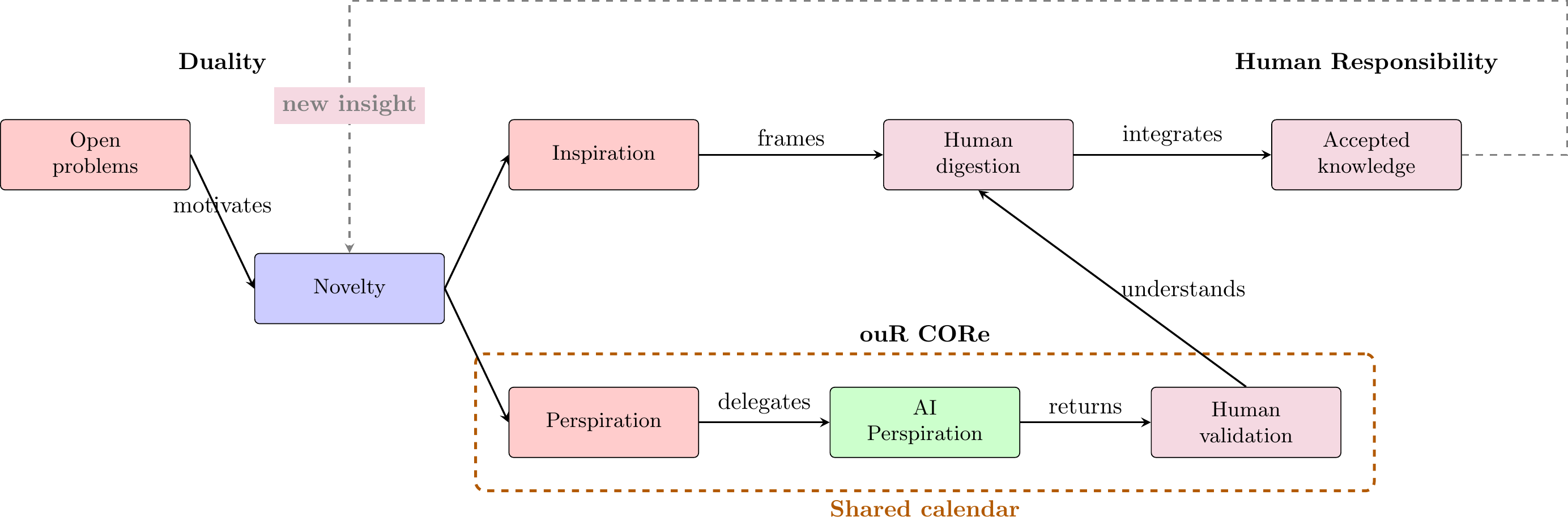
Research begins with open problems and the human motivation to find new answers. The human contribution is not merely a task to be executed, but the context and the reason why a problem is worth exploring now.
Between a problem and a novel contribution lies a process involving both inspiration and effort. Inspiration can emerge during execution, and effort can generate new ideas. Yet distinguishing between them helps identify which activities can be delegated and which must remain under human responsibility.
Results do not automatically become accepted and promoted knowledge. They enter a process of human validation, in which their correctness, relevance, and limitations are examined. The shared calendar encompasses human effort, effort delegated to AI, and the validation of results. The point is that these should not be viewed as isolated stages, each performed only once, but as activities coordinated over time.
The human can reformulate the task, AI can return intermediate results, and validation can lead to further calculations or a revised approach. The shared calendar provides the framework for this iterative collaboration. Delegation, therefore, does not mean the disappearance of human effort, but its redistribution: less effort devoted to certain operations and more attention given to problem formulation, verification, and interpretation.
The loop does not guarantee progress. Some results may be rejected, some hypotheses may prove wrong, and some lines of inquiry may reach a dead end. This is precisely why revisiting the problem and revising hypotheses are essential parts of the process.
OuR CORe Values Link to heading
Transparency is essential, but not necessarily symmetric. AI-generated outputs must be sufficiently transparent to allow human inspection, verification, and understanding. The human contribution, however, need not be fully exposed to AI: intuition, exploratory thinking, and the emergence of new ideas must remain, at least in part, inaccessible to AI. What matters is that AI-generated outputs can be critically assessed before being accepted, while helping humans identify and cultivate their distinctive contributions.
Human and AI contributions need not mirror each other. Their value lies in complementary capabilities: humans provide motivation, context, and judgment, while AI can support exploration, computation, and execution. Specialization allows each to contribute where it is most useful, without assuming that either can replace the other.
Collaboration is more than task delegation. It is an iterative process in which human direction shapes AI effort, AI results inform human thinking, and validation guides further work. The objective is not simply to accelerate execution, but to turn complementary contributions into knowledge that humans can understand, assess, and responsibly accept.
The Actuarial Parallel Is Not a Metaphor Link to heading
The entire actuarial profession exists because models that look good on the surface sometimes rely on assumptions that have silently ceased to hold. We do not treat this as a marginal case, and we have built an entire framework of cross-checks and disclosures precisely because this happens routinely.
Plausible but incorrect is not a new risk that the Leiden Declaration has discovered for mathematics. It is the oldest risk in reserving, underwriting, and pricing. What is new is the source. That is why I expected more actuaries to sign3. The declaration emerged from within the mathematical community, in response to a problem affecting the rigour of mathematical research. Yet, with almost no translation, it is an exact description of the discipline that actuarial standards of practice already seek to impose on every model we use. We should not need to be told twice.
Backup Plan Link to heading
Here is the part I think is easy to miss on a first reading: the declaration’s recommendations—verification, attribution, transparency—are not fundamentally about restricting AI. On the contrary, they should ensure that there is always a second independent method, one that does not share the first method’s blind spot.
That last condition matters more than it might seem. A backup plan does not mean run it twice or get a second opinion. A genuine backup is a method built on different assumptions: on different initial conditions.
The obligation is not symmetric: an AI system used in professional practice must be deployed with its own honest mechanism for backing off, a willingness to signal the limits of its competence rather than produce a fluent answer regardless of whether the premises on which it rests still hold. Neither party in this collaboration should be assumed capable of identifying its own blind spots. This is not a criticism of either party—it is simply what independent must mean for a backup plan to be worth having.
The Central Idea Link to heading
The proposal is neither that AI replaces the researcher nor that any result produced by AI can become knowledge through superficial verification. It is an architecture in which producing results, verifying them, and taking responsibility for the knowledge they represent are distinct but interdependent functions.
AI can extend our capacity for exploration and execution. Humans retain responsibility for conceptual framing, acceptance criteria, and the justification of conclusions. Accepted knowledge, in turn, is not an endpoint, but a source of the next perspective.
This is neither caution for caution’s sake nor a call for a pause. Structural limits are determined by the initial conditions: not every piece of information should be shared with every agent. Sensitive data, specific context, and knowledge that underpin a competitive advantage must remain under the control of those who hold them.
This way of thinking defines the core of Actuarial Mathematics, particularly as illustrated by credibility theory.
 You don’t need to know everything. You need to know what to ask, what initial conditions to start from, what to verify, and whom to entrust with the problem.
@online{Cornaciu2026BeyondLeiden,
  author   = {Cornaciu, Valentin},
  orcid    = {0000-0001-9239-7145},
  title    = {Beyond the Leiden Declaration},
  year     = {2026},
  date     = {2026-10-23},
  url      = {http://rcor.ro/posts/2026-10-02-beyond-the-leiden-declaration/},
  abstract = {An analysis of the limitations of the Leiden Declaration and the
  implications of human-AI collaboration, focusing on transparency, specialization,
  validation, and the availability of independent backup methods.}
}
-
See the OpenAI Math project history, including the corrections already provided, as an illustration of why plausible but incorrect mathematical results require careful scrutiny before they can be trusted. ↩︎
-
An AI-generated refutation of an 80-year-old conjecture that received extensive media coverage, announced on what the declaration itself calls a corporate market calendar, ahead of the community’s accepted evaluation process. ↩︎
-
At the time of publication, I appear to be the only actuary who has engaged with this initiative. The near-total absence of the actuarial community from such debates suggests a troubling disconnect: we are quick to adopt the efficiency of AI tools, yet leave the debate about the rigour, verification, and validation of their outputs to others. ↩︎