
Markets do not reward averages. They reward segmentation.
Segmentation should not be confused with separation. The objective is not to isolate risks from one another, nor to discard information through excessive fragmentation. Quite the opposite: meaningful segmentation requires integrating all available information in order to explain not only the expected value, but also the structure of volatility surrounding it.
In actuarial science, the temptation to remain close to the market mean is almost structural. Benchmarking exercises, peer comparisons, regulatory pressure, rating and audit constraints, and committee-driven governance all pull insurers toward the same gravitational center: the comfort of being approximately identical.
Yet competitive advantage rarely emerges from being approximately correct. It emerges from being significantly different.
The market mean is rarely wrong enough to collapse immediately. It is merely insufficiently differentiated to generate persistent excess returns. Profitable segmentation often comes not from finding lower frequency, but from finding lower volatility conditional on exposure.
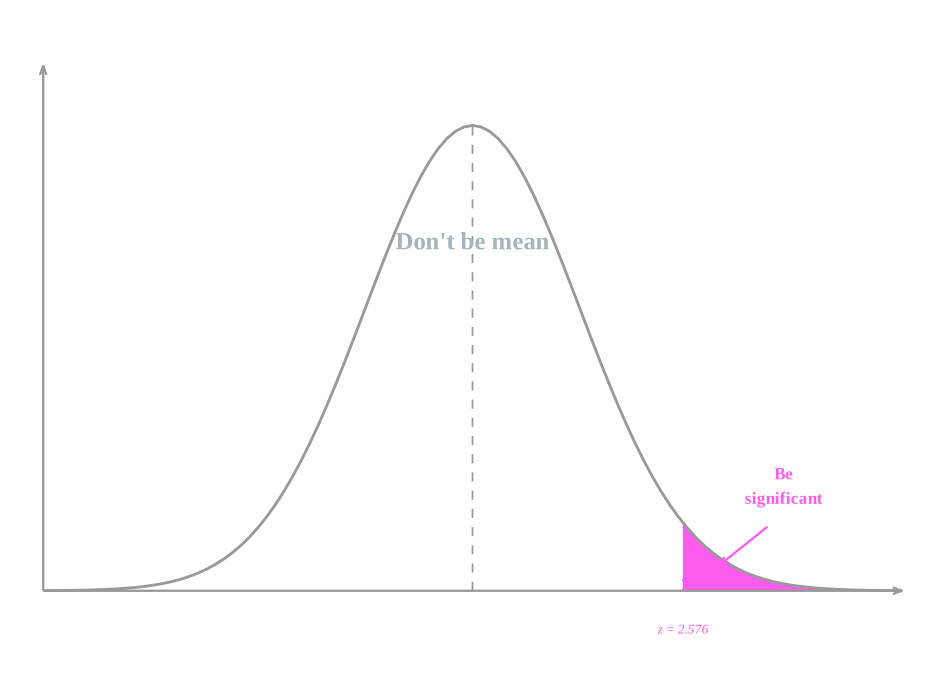
The comfort of the simplified mean Link to heading
The mean is elegant mathematically because it compresses uncertainty into a single representative value. It stabilizes communication, simplifies reserving, and supports solvency calculations. Estimating the average while ignoring volatility is a great mistake.
But the market itself is not compensated for producing stable averages. A portfolio positioned exactly at the market mean will, over time, tend toward market-average profitability adjusted for market-average risk. This is not failure. It is equilibrium.
The difficulty appears when insurers confuse:
- simplified statistical centrality with
- economic optimality.
These are not equivalent. In highly competitive insurance markets, being close to the average often means:
- competing on insufficient margins;
- inheriting the same blind spots as competitors;
- accumulating correlated exposures;
- reducing strategic flexibility.
Ironically, excessive alignment with the mean can itself become a source of systemic risk.
Significance as competitive edge Link to heading
Actuarial significance is often treated narrowly as a statistical threshold. In practice, significance has a broader economic interpretation.
A signal becomes valuable when it changes decisions. This distinction matters.
A variable may be statistically significant but economically irrelevant. Conversely, a weak but persistent structural signal may generate substantial long-term competitive advantage if competitors systematically ignore it.
The actuarial challenge is therefore not merely to detect significance, but to identify significance that survives:
- regulation;
- capital constraints;
- operational implementation;
- portfolio interaction effects;
- behavioral adaptation of policyholders.
This is where many pricing systems fail. They optimize local statistical fit while ignoring strategic equilibrium.
Segmentation versus commoditization Link to heading
Every mature insurance market eventually faces the same pressure: commoditization1. Once competitors possess comparable datasets, comparable models, and comparable infrastructure, pricing converges.
Segmentation becomes economically meaningful only when it produces pricing differentials large enough to matter after:
- acquisition costs;
- operational friction;
- capital charges;
- anti-selection effects.
Otherwise, segmentation degenerates into decorative analytics. Many insurers today possess extremely sophisticated models that generate statistically refined but strategically irrelevant distinctions.
The model improves. The economics do not.
Volatility is not noise Link to heading
A common actuarial instinct is to reduce volatility wherever possible.
This is understandable. Volatility complicates reserving, capital planning, earnings stability, and investor communication.
But volatility is also information. In competitive environments, the highest informational value often resides precisely where variance increases.
Stable segments are usually already efficiently priced. Unstable segments may contain:
- adverse selection exposures;
- emerging behavioral trends;
- changing fraud dynamics;
- climate transition effects;
- technological disruption.
The objective is therefore not the elimination of volatility itself, but the ability to distinguish:
- compensated volatility;
- uncompensated volatility.
This distinction defines actuarial maturity.
The hidden danger of excessive consensus Link to heading
Consensus2 feels safe because individual accountability becomes diluted. If every insurer prices similarly, individual failure becomes harder to isolate. But from a systemic perspective, excessive consensus can produce synchronized fragility.
Under such conditions, diversification becomes partially illusory. Entire markets may become vulnerable to identical modeling errors.
The actuarial profession should therefore remain cautious whenever convergence becomes too comfortable — particularly because the measures it works with are, in general, non-additive. The mean is additive, but not self-sufficient. Its correct determination requires a complete and unified model — one that links risk factors simultaneously to both location and dispersion. Without such a structure, the mean is not an inference, but a conjecture presented as one.
The elegance of additive models is also their limitation: they impose linearity on phenomena whose underlying structure may not be linear at all. Uniformity is often interpreted as evidence of correctness. Sometimes it is merely evidence of shared blindness.
Don’t be mean Link to heading
The phrase is intentionally ambiguous. It does not suggest abandoning rigor, discipline, or prudence. Nor does it imply that every deviation from consensus represents undesirable risk. Rather, it highlights a strategic actuarial principle:
true competitive advantage lies not in the mean, but in mastering what surrounds it. Significance — in both senses — emerges when expectation and volatility are modeled jointly, allowing us to distinguish between frequency and uncertainty, exposure and instability.
A rigorous pricing framework models both the expected value and its dispersion as functions of risk factors — because volatility is not noise to be averaged away, but information to be segmented, understood, and priced.
A poorly conditioned mean is a dangerous simplification. The goal is not to abandon the expected value — it remains the destination — but to earn it: by conditioning on every material risk factor, and by acknowledging that dispersion around it is not residual noise, but structure yet to be explained.
A similar principle appears in IAS 19 employee benefit valuation, where obligations cannot be modeled solely through simple expected employee turnover rates, but must also reflect the volatility and uncertainty surrounding employee departure behavior3.
The actuarial profession was never merely about calculating averages. Its deeper purpose is identifying which deviations matter — before everyone else notices them.
This mindset defines the core of Actuarial Mathematics, especially through credibility theory.
 You don’t need to master every detail — you just need the right actuary to build the right model.
@online{Cornaciu2026Mean,
  author   = {Cornaciu, Valentin},
  orcid    = {0000-0001-9239-7145},
  title    = {Don’t be mean, be significant!},
  year     = {2026},
  date     = {2026-05-17},
  url      = {https://rcor.ro/posts/2026-05-16-don-t-be-mean-be-significant/},
  abstract = {The article explores the role of optimal segmentation, arguing that
  competitive advantage does not arise from proximity to the market mean, but from
  the ability to jointly model both expected value and volatility.}
}
-
Commoditization is the process by which services lose their competitive differentiation over time and become generic, interchangeable commodities. ↩︎
-
By consensus we do not mean explicit coordination among market participants, but the implicit convergence of models and decisions produced by similar institutional constraints, where familiar simplifications are often preferred to more complex solutions because they reduce operational friction and individual decision-making risk. ↩︎
-
Employee turnover rates should be modeled not only through their expected level, but with explicit consideration of the volatility and uncertainty around that expectation, since the mean remains the target quantity, while the surrounding dispersion materially affects the valuation of long-term employee benefit obligations. ↩︎