
Beauty wakes up on Monday morning.also on Tuesday, if Tails.with no memory, every time anew.when asked about her credence in Heads.
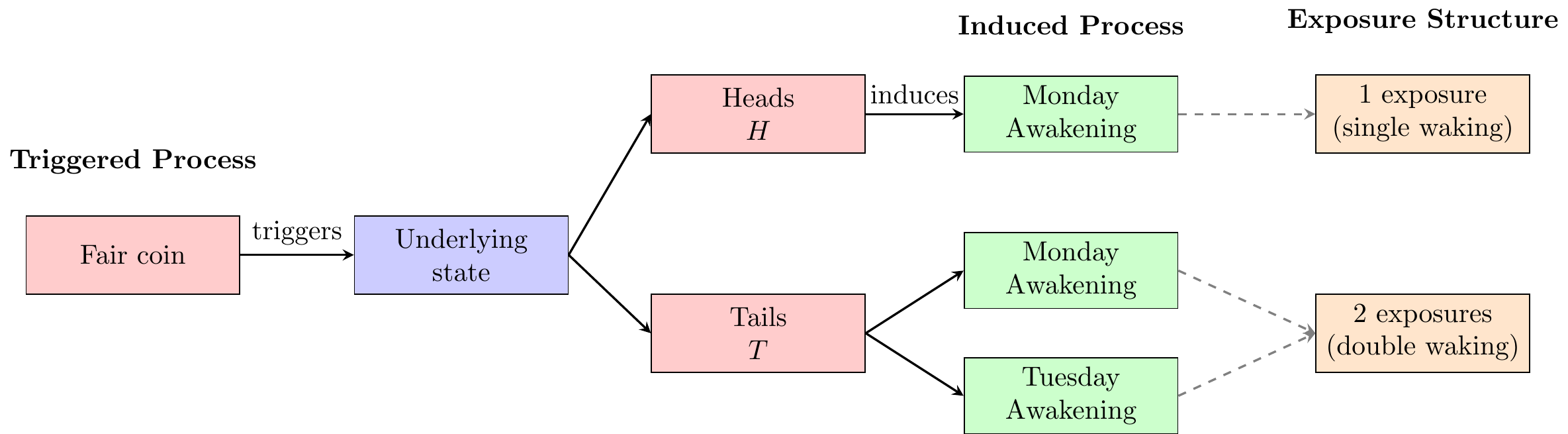
We have discussed before the distinction between a process being triggered and an outcome being induced. The distinction may look semantic at first sight, but it becomes probabilistically important whenever the observation available to an agent is produced by a mechanism that selects, filters, or repeats possible states.
The Sleeping Beauty problem, as introduced by Elga Elga (2000), is formulated as follows:
Some researchers are going to put you to sleep. During the two days that your sleep will last, they will briefly wake you up either once or twice, depending on the toss of a fair coin (Heads: once; Tails: twice). After each waking, they will put you to back to sleep with a drug that makes you forget that waking. ❓When you are first awakened, to what degree ought you believe that the outcome of the coin toss is Heads❓
The difficulty arises when Beauty is awake and does not know whether it is Monday or Tuesday. The standard question is therefore:
P(H\mid \text{first awakening})
Two principal answers have emerged in the literature:
\frac12
\qquad\text{and}\qquad
\frac13.
How should we update de dicto beliefs in the face of de se evidence?1
The motivation for this post came the moment I saw the answers given by AI agents: all of them were thirders at the time of the post. Before that, I had regarded the Sleeping Beauty problem as deliberately under-specified — almost as if it had been designed to excite philosophers rather than to settle a probabilistic question.
What exactly is the probability question? Link to heading
In the Jaynesian sense, a probability question is not fully specified merely by listing the possible outcomes. We must also specify the information available to the observer and the proposition whose plausibility is being assessed. Jaynes (2003)
In the Sleeping Beauty problem, this distinction is crucial. The underlying random experiment is simple: a fair coin is tossed, triggering either Heads or Tails. But Beauty is not asked about the coin toss immediately. She is asked a question after an observational situation has been generated by a protocol that depends on the outcome of the toss.
Thus, there are at least two different levels to keep apart:
- the underlying state of the experiment: Heads or Tails;
- the observational state in which Beauty finds herself: an awakening with particular temporal or experimental characteristics.
The probability question is therefore not simply
P(\mathrm{Heads}\mid \text{triggered only}) = \frac{1}{2},
but rather something of the form
P(\mathrm{Heads}\mid \text{information available to Beauty}).
The difficulty lies precisely in specifying what belongs to that information.
If Beauty’s evidence is only that she is awake, then this evidence may have been induced by the experimental protocol in different ways under Heads and Tails. If, instead, the relevant evidence includes information that identifies the particular awakening, the conditioning information is different.
This is the point at which the distinction between de dicto and de se belief becomes relevant. The former concerns the underlying proposition — for example, whether the coin landed Heads — whereas the latter concerns Beauty’s own position within the experiment: which awakening am I experiencing?
Consequently, before asking whether the answer is $ 1/2$ or $ 1/3$, we should first ask a more fundamental question: What exactly is the evidence on which the probability is conditioned?
Only after that question has been answered is the probability calculation fully specified.
The contribution of this post Link to heading
Real options reprice $ P$ into a risk-neutral $ Q$ because of a replication/no-arbitrage argument tied to the asset’s own dynamics — not because the same realization gets sampled with unequal multiplicity, which is the mechanism actually at work in Sleeping Beauty.
What does transfer is the general principle beneath both: whenever an agent is subjected to a repeated wager through induced exposure across the states of the centered world, the total price charged by a rational counterparty tracks the frequency with which the wager is actually enforced—whether priced once per toss or at every awakening—rather than the raw frequency of the underlying state. Sleeping Beauty happens to be a case where this mechanism can be made exact — not through a stock, but through a casino game built with exactly the same replay structure as the experiment itself.
Under the halfer interpretation, the entry price is paid once, for the underlying coin toss. There is one random experiment, and the relevant probability of Heads is therefore $ 1/2 $.
Under the thirder interpretation, the entry price is paid for each mandatory awakening. The same underlying coin toss can therefore generate multiple paid exposures. Once the payment is attached to the awakening rather than to the toss itself, the relevant reference class can be calibrated, and the corresponding break-even probability becomes $ 1/3 $
The Missing Layer: Exposure Link to heading
To bridge the gap between the underlying random experiment and Beauty’s subjective probability, we need a intermediate concept: exposure.
- The coin toss determines the true state of the world.
- The induced mechanism determines how many times that state is exposed to the subject.
The longstanding dispute between Halfers and Thirders can be reframed as a disagreement over the appropriate unit of exposure:
- The Halfer interpretation treats the coin toss as the unit of exposure (the subject is exposed once per state realization).
- The Thirder interpretation treats each mandatory awakening as a separate unit of exposure.
By framing exposure in financial terms—as an entry price $ p$ paid per exposure to win a payoff—we can transform this philosophical dilemma into a concrete economic pricing problem.
Extended Casino Construction: Sequential Opportunities Link to heading
Consider a casino that pays one monetary unit for each winning play — landing Heads. Suppose that the mechanism generates a sequence of opportunities, with the same underlying coin determining the successive outcomes. The customer pays the entry price $ p $ for each exposure generated by the mechanism.
The relevant quantity is therefore not only the probability of each path, but also the number of times the customer is charged along that path.
Now suppose that customers are offered a contract consisting of three consecutive plays2. Importantly, both halfers and thirders calculate the probability of winning all three plays in exactly the same way:
P(\text{three wins}) = \left(\frac{1}{2}\right)^3 = \frac{1}{8}.
Let $ X $ be the net payoff from one complete realization of the game. At each awake observation, the player pays $ p $. The valid possible paths and their associated net payoffs are:
|
Path |
Probability |
Payoff |
Net payoff |
|---|---|---|---|
|
HHH |
1/8 |
3 |
3 - 3p |
|
HHT |
1/8 |
2 |
2 - 3p |
|
HT |
1/4 |
1 |
1 - 3p |
|
TH |
1/4 |
1 |
1 - 3p |
|
TT |
1/4 |
0 |
-3p |
Hence, the expected net payoff $ E(X) $ is calculated as:
E(X)
=
\frac{1}{8}(3 - 3p)
+
\frac{1}{8}(2 - 3p)
+
\frac{1}{4}(1 - 3p)
+
\frac{1}{4}(1 - 3p)
+
\frac{1}{4}(-3p)
E(X)
=
\left( \frac{3}{8} + \frac{2}{8} + \frac{1}{4} + \frac{1}{4} \right)
-
\left( \frac{3}{8} + \frac{3}{8} + \frac{3}{4} + \frac{3}{4} + \frac{3}{4} \right) p
E(X)
=
\frac{9}{8} - 3p.
The break-even price per observation is therefore:
p^* = \frac{3}{8}.
As a monopolist, the casino can set an entry price close to $ 1/2 $, assuming that its marginal customers are willing to pay approximately this amount for a single play. In competition, however, the entry price is pushed down to $ 3/8 $, which is the price at which the marginal customer is indifferent between entering and not entering the market.
Comparison with the Canonical Sleeping Beauty Mechanism Link to heading
In the canonical Sleeping Beauty mechanism, a Heads outcome dictates $ 1 $ awakening (cost $ p $, payoff $ 1 $), while a Tails outcome dictates $ 2 $ awakenings with $ 0 $ payoff (cost $ 2p $), without any subsequent branching:
|
First toss |
Probability |
Number of awakenings |
Payoff |
Net payoff |
|---|---|---|---|---|
|
H |
1/2 |
1 |
1 |
1 - p |
|
T |
1/2 |
2 |
0 |
-2p |
Consequently, the expected value per full realization is:
E(X)
=
\frac{1}{2}(1 - p)
+
\frac{1}{2}(-2p)
=
\frac{1}{2} - \frac{3}{2}p.
The break-even price per awakening is then:
p^* = \frac{1}{3}.
This yields the exact Thirder price: the expected payoff per realization is $ 1/2 $, while the expected number of paid awakenings is $ 3/2 $, resulting in a fair market price of $ 1/3 $ per observation.
The difference arises not from the probability of the underlying sequence, but from the way the customer values the three opportunities. Let $ \eta $ denote the customer’s reservation value for the three-play opportunity. A customer enters whenever the expected net value satisfies
3 - 3p > \eta,
where $ p $ is the price of one play. Thus, customers with a lower $ \eta $ enter at a higher price, while customers with a higher $ \eta $ require a lower price.
Under monopoly, the casino can exploit the distribution of $ \eta $ and choose the price that maximizes its profit. Once competing casinos are introduced, however, customers with higher reservation values become contestable. Price competition therefore pushes the entry price downward and generates a new equilibrium threshold $ p^* $.
The important point is that the competition does not change the underlying probability calculation. Everyone still agrees that
P(\text{three wins}) = \frac{1}{8}.
What changes is which customers are brought into the market and at what price. In the limiting competitive case, the relevant marginal customer can be the one for whom the three-play opportunity is valued at approximately $ 1 $, giving a per-play threshold of approximately $ 1/3 $.
This provides the economic intuition for the appearance of a new $ p^* $. The difference between $ 1/2 $ and $ 1/3 $ need not come from different beliefs about the underlying experiment. It can arise because the mechanism changes the set of observations that are economically relevant and, through competition, changes the marginal participant whose valuation determines the price.
A constructor-theoretic perspective: what can be brought about? Link to heading
What follows is not a report of a Deutschian conclusion, but a novel application of Deutsch’s own framework, constructor theory Deutsch (2013), to the question this past has been circling throughout. The phrase what can be brought about is not a loose paraphrase; it is constructor theory’s technical vocabulary, and taking it literally is what makes the application precise rather than merely evocative.
The relevant piece of the framework. Constructor theory reformulates physical claims not as predictions about trajectories, but as counterfactuals3 about tasks: a task is possible if some constructor exists that can perform it and remain able to perform it again; a task is impossible if no constructor, of any construction, could perform it even approximately. Impossibility claims of this kind are not gaps in present knowledge — they have the same status as conservation laws.
Two tasks, not one. Sleeping Beauty’s protocol involves two tasks that must not be run together:
- $ T_{trigger}$: toss a fair coin and fix its outcome. This task is possible, and — this is the load-bearing point — the task toss the coin again, independently, within this same run is not available once $ T_{trigger}$ has been performed. There is exactly one triggered fact per run, by construction, not by stipulation.
- $ T_{induce}$: given whatever the coin already shows, prepare an awakening indistinguishable from any other awakening in the protocol. This task is repeatable — that is precisely what the amnesia condition buys — but every one of its repetitions takes the already-fixed4 coin outcome as input. Running $ T_{induce}$ twice under Tails does not run $ T_{trigger}$ twice.
This sharpens the triggered/induced distinction used throughout this paper into a constructor-theoretic claim rather than a metaphor:
What is induced by the mechanism must not be confused with what is triggered by the underlying random experiment — because the task that would turn one into the other (independently re-triggering the coin) is not among the tasks the protocol makes available.
What this buys, precisely.
- It gives the halfer’s core objection a sharper, non-question-begging form. The halfer is not merely asserting no new information arrived; the halfer can now state exactly which task did not occur: no second performance of $ T_{trigger}$ took place on Tuesday, and if credence is a functional of $ T_{trigger}$’s output alone, nothing available to Beauty at any awakening is capable of moving it.
- The thirder’s reply is equally sharpened: credence, on this view, is not a functional of $ T_{trigger}$’s output alone — it tracks which induced state Beauty currently finds herself in. However, converting this structural distribution into a $ 1/3$ credence requires an explicit, additional bridge.
What this does not buy: what cannot be brought about?
- Constructor theory supplies the vocabulary to state, without equivocation, which quantity each side takes credence to track — $ T_{trigger}$’s outcome, or $ T_{induce}$’s outcome.
- It does not, on its own, adjudicate which of the two a rational agent’s credence is obliged to track; that is a further, substantive question about the semantics of self-locating belief, and it is exactly the de dicto versus de se question raised earlier in this paper, now visible as the same fork from a different direction.
Observation, reporting, and conditional probability Link to heading
This perspective connects directly to the earlier discussion of observation and reporting in conditional probability Cornaciu (2026). The crucial point is that an observation does not merely reveal information about an underlying state of the world; it may also define the reference class over which the conditional probability is evaluated.
In particular, conditioning on an event and conditioning on the fact that an event was reported are not necessarily the same operation. The reporting mechanism determines which observations enter the reference class and, therefore, can change the resulting conditional probability.
This distinction is especially relevant in Sleeping Beauty. The issue is not simply what Beauty knows when she awakens, but what constitutes the observation on which the probability is conditioned. Once the reporting or observation mechanism is made explicit, apparently competing probabilities can be seen as answering different conditional questions rather than representing two numerical answers to the same question.
Computational Agents and de se Information Link to heading
Artificial intelligence agents and large language model (LLM) instances almost universally resolve to the thirder position ($ P() = 1/3$) when evaluated on the Sleeping Beauty protocol. The model’s answer is generated from the information available in that local execution. This alignment is not an artifact of philosophical bias5, but a direct consequence of the computational execution model:
Inherent de se evaluation. When queried about its current state, a language model evaluates the problem from a de se perspective: its answer is conditioned on the information available to the current inference instance.
Core takeaway: For a computational agent, being awakened is structurally identical to being instantiated. To force an AI agent into Halfism, one would need to supply an explicit state variable that intentionally unweights its second execution step—forcing it to reason outside its own execution architecture.
Conclusion Link to heading
If you think that the process is triggered, you are a Halfer. If you think that the process is induced, you need a bridge assumption for the different probabilities to emerge. The difference is not in the underlying probability of the coin toss, but in the way the observation mechanism generates exposure to the subject.
In Deutsch’s epistemological framework, probabilities are never read off directly from physical states; they are derived from conjectured explanations regarding rational decision-making under uncertainty. Here lies the exact role of exposure: while Constructor Theory restricts physical reality to allowed vs. forbidden tasks, exposure enters not as a primary physical property, but as a necessary bridge assumption within a conjectured explanation.
When asked to decide6, I would enter the casino game if the premium is less than $ 0.5 $ when payment is made once per toss, but only if it is less than $ 1/3 $ when payment is required at each awakening.
This mindset defines the core of Actuarial Mathematics, especially through credibility theory.
 You don’t need to master every detail — you just need the right actuary to build the right model.
@online{Cornaciu2026ExposingBeauty,
  author   = {Cornaciu, Valentin},
  orcid    = {0000-0001-9239-7145},
  title    = {Exposing Sleeping Beauty: Triggered or Induced?},
  year     = {2026},
  date     = {2026-09-28},
  url      = {https://rcor.ro/posts/2026-08-23-exposing-sleeping-beauty-triggered-or-induced/},
  abstract = {This article revisits the Sleeping Beauty problem through the
  distinction between triggered and induced processes. It argues that the
  disagreement between the 1/2 and 1/3 answers cannot be understood without
  first specifying the event on which the probability is conditioned and the
  mechanism by which the relevant exposure is generated. The article introduces
  exposure as a possible reweighting mechanism and shows that the 1/3 answer
  requires an additional assumption concerning the sampling of exposures,
  whereas if the induced situation is identified with the triggered experiment,
  the answer remains 1/2.}
}
Cornaciu, Valentin. 2026. “Observation and Reporting in Conditional Probability — One Ace Versus the Ace of Hearts.” June 2, 2026. https://rcor.ro/posts/2026-05-24-observation-and-reporting-in-conditional-probability-one-ace-versus-the-ace-of-hearts/.
Deutsch, David. 2013. “Constructor Theory.” arXiv Preprint arXiv:1210.7439. https://arxiv.org/abs/1210.7439.
Elga, Adam. 2000. “Self-Locating Belief and the Sleeping Beauty Problem.” Analysis 60 (266): 143–47. https://joelvelasco.net/teaching/3865/elga%20-%20self%20locating%20belief%20and%20the%20sleeping%20beauty%20problem.pdf.
Jaynes, Edwin T. 2003. Probability Theory: The Logic of Science. Edited by G. Larry Bretthorst. Cambridge: Cambridge University Press. https://altexploit.wordpress.com/wp-content/uploads/2017/07/e-t-jaynes-probability-theory-the-logic-of-science.pdf.
-
De dicto beliefs concern a proposition considered independently of the believer’s particular identity or position — roughly, beliefs about “the world as described.” De se evidence is information about oneself or one’s own location within a situation — roughly, “this is me” or “this is where I am.” In the Sleeping Beauty problem, the distinction matters because Beauty may know that she is awake without knowing which awakening she is experiencing. The evidence is therefore not merely about the underlying world (Heads or Tails), but also about her own location within that world. ↩︎
-
The three-play contract is a hypothetical construct designed to illustrate the economic intuition behind the Thirder position. It is not part of the original Sleeping Beauty problem but serves as an analogy to explain how the mechanism of induced exposure can lead to a different break-even price per observation. ↩︎
-
regard scientific theories as conjectured explanations, not as inferences from evidence, and observation not as a means of validating them, but only of testing them. ↩︎
-
The coin outcome is fixed by the first task, but it is not thereby revealed to the agent. “Already-fixed” is used here in the causal or protocol-level sense, not in the epistemic sense: the outcome has been determined within the experiment, while remaining unknown to the agent. ↩︎
-
The thirder answer is not forced by the protocol itself: as the analysis in this paper shows, reaching it requires an additional premise — equal weight per awakening rather than per branch — that the protocol does not supply. Consistent with this, the AI appears to have adapted its answer after being presented with the argument developed here (an observation from a single conversation, not a demonstration). ↩︎
-
The distinction is not in the underlying probability of the toss, but in the exposure generated by the payment mechanism: one toss produces one payment, whereas the Sleeping Beauty protocol can produce two payments under Tails. ↩︎